
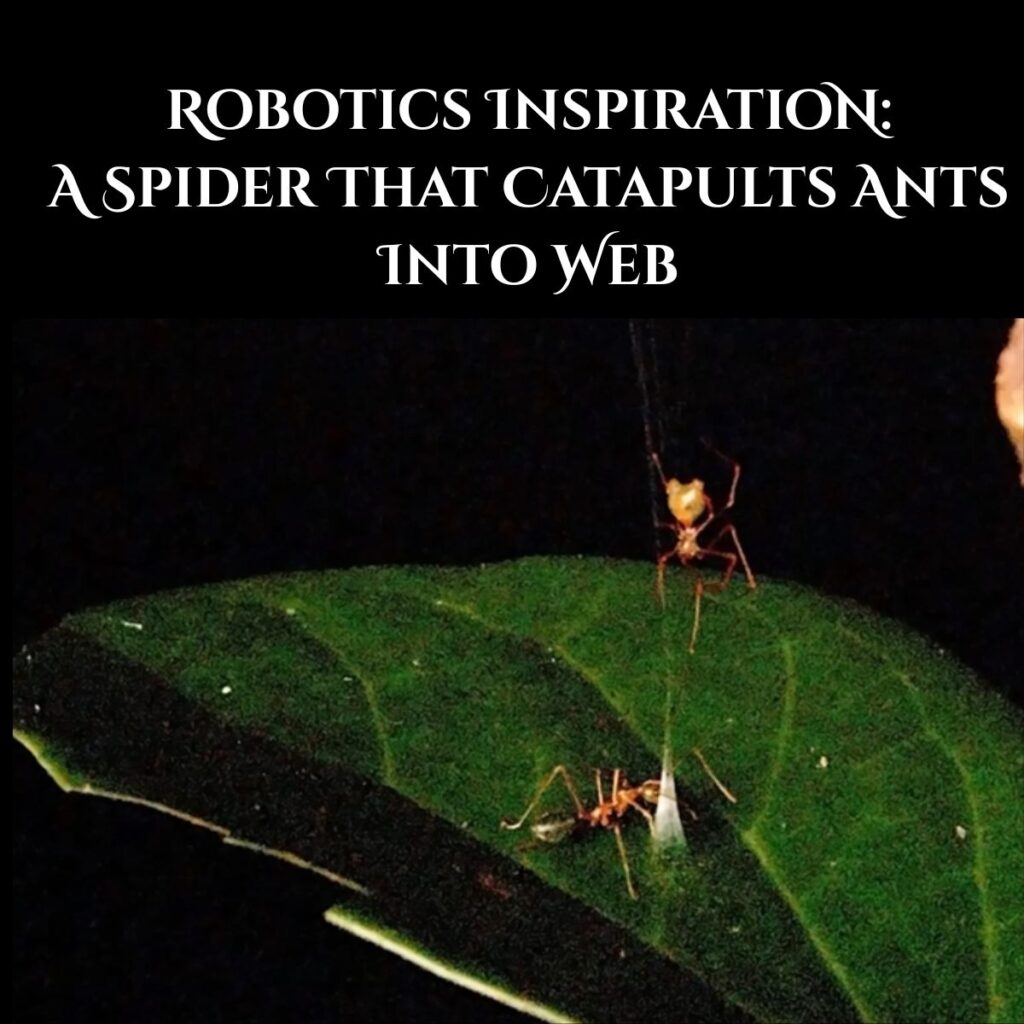
Did you know spiders rarely go after ants? Ants are notoriously dangerous as an attack on one prompts retribution by many.
…enter an Australian spider with Ballistic high-powered spider webs …
➡️ This newly discovered Australian arachnid has engineered a spring‑loaded silk trap that literally yeets hostile green tree ants into a web.
Here’s the setup: the spider stretches silk lines like a loaded slingshot, anchors it to a leaf (or branch or forest floor), complete with a lure (they think a phermone powered one). When an ant approaches it aggressively starts biting the silk, triggering the release.
The silk catapult fires the ant at up to 130 g of acceleration into a waiting web, about half a meter away. The spider doesn’t even have to be there to pull the trigger; the ant basically launches itself.
From a biomechanics perspective, this is a wild example of tension storage and remote triggering.
The ballista spider is out here doing behavioral engineering, conflict management, and mechanical design…all with spider silk and patience.
Researchers are studying the ballista spider’s silk and snare design as a bioengineered, high–power-density elastic material that can store and rapidly release energy, potentially inspiring new spring-loaded fibers and micro‑scale catapult systems in materials science and soft robotics.
💡 Yet, another example of how biodiversity inspires innovation!
Reference: Ajay Narendra, Pranav Joshi, Daniele Liprandi, Gregory J. Anderson, Jonas O. Wolff. Ballistic high-powered spider webs overcome dangerous prey defenses. Current Biology, 2026; 36 (12): R691