
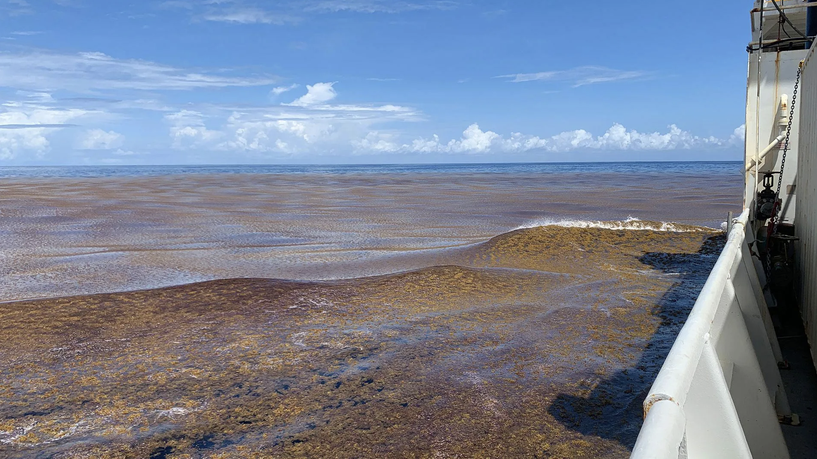
A new global analysis of 1.2 million satellite images suggests that floating algae blooms (including macroalgal mats such as Sargassum and Ulva) have expanded substantially across the world’s oceans.
Using AI to interpret two decades of imagery, researchers found:
Surface microalgal blooms increased globally by about 1% per year between 2003 and 2022.
In the tropical Atlantic and western Pacific, floating macroalgae expanded by 13.4% annually.
Major macroalgal bloom events began emerging after 2008, including Ulva in the Yellow Sea and Sargassum in the tropical Atlantic.
➡️ The investigators point out a potential global “regime shift” from a macroalgae-poor to a macroalgae-rich ocean.
💡 This is not a simple good-news/bad-news story.
In offshore environments, floating seaweed can create habitat, nursery grounds, and food-web complexity. But when massive quantities accumulate along coastlines, decomposition can degrade nearshore ecosystems, create odor and health concerns, disrupt tourism, and impose major costs on coastal communities.
The likely drivers are also interconnected: nutrient runoff, changing currents, warming waters, and climate variability may each contribute differently across regions.
This is a good example of how biomass is not inherently “abundance” in a beneficial sense, but a more complex issue.
Reference: Lin Qi, Menghua Wang, Brian B. Barnes, Douglas G. Capone, Joaquim I. Goes, Edward J. Carpenter, Yuyuan Xie, Chuanmin Hu. Global floating algae blooms are expanding. Nature Communications, 2025; 17 (1)