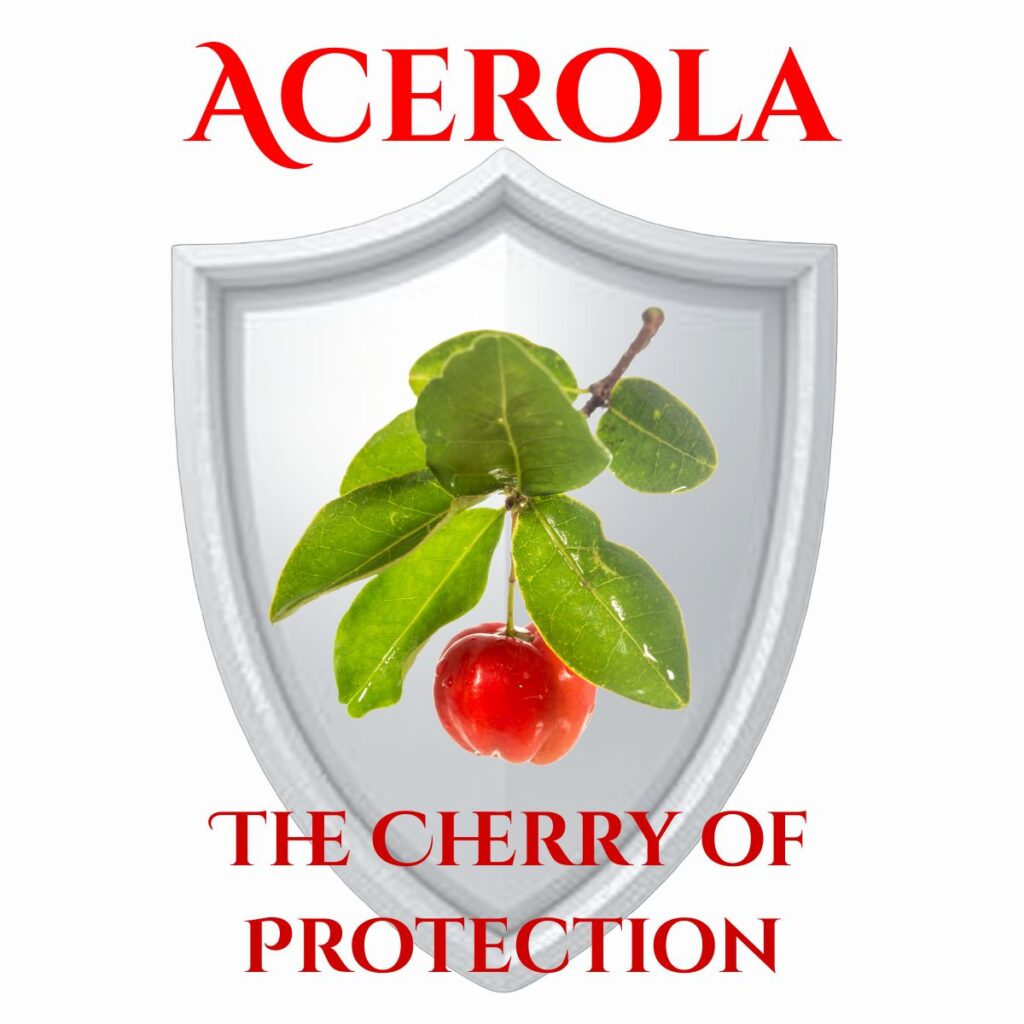
A native to South & Central America, and Mexico, Acerola (Malpighia emarginata) is a shrub or small tree that bears a bright red fruit (drupe) that is like a small cherry with a sour (sometimes a little sweet) flavor.
➡️ These fruits are very high in Vitamin C content, known as one of the richest Vitamin C sources in the world!
The content of Vitamin C varies, depending on the strain and environmental conditions, between 1500-4500 mg/100 g, making it 50-100 times higher than oranges or lemons.
The fruit is edible and used in making a variety of foods and beverages, especially in its native range, but also for export markets as a Vitamin C source.
Beyond its Vitamin C content, it also contains Vitamins A, several B Vitamins, carotenoids, phenolics and flavonoids, which contribute to its high antioxidant and protective properties.
Due to this phytochemical make up it has protective benefits to the metabolism and membranes, and it has also been confirmed in studies to have a skin whitening effect, useful for anti-aging applications, as well as a multidrug resistant reversal activity.
Exciting areas of new research point to energizing and protective benefits, and include the finding that a pectic polysaccharide in Acerola has anti-fatigue activity, also Acerola’s crude extract was able to improve antioxidant enzyme activities and mitochondrial functionality.
Adding to these studies, Acerola juice was able to improve the brain energy metabolism in mice fed a “palatable cafeteria diet”, leading the researchers to conclude that Acerola could partially revers alterations in energy metabolism caused by obesity.
It has also been shown that Acerola could improve antioxidant defenses, biological and genotoxic parameters, and protects against negative effects of the inflammation and lipolysis pathway alterations caused by the “cafeteria diet”.
One notable human study compared the absorption and excretion of synthetic ascorbic acid with that from acerola juice in healthy Japanese subjects, finding that some component(s) in acerola juice appeared to favorably enhance vitamin C absorption and handling relative to isolated ascorbic acid, suggesting a synergistic effect of its natural matrix. Animal experiments have shown that acerola leaf extract can significantly increase serum catalase activity and lower serum TNF‑α, supporting both antioxidant and anti‑inflammatory actions at the systemic level.
Acerola: The Cherry of Protection 🛡️ 🍒