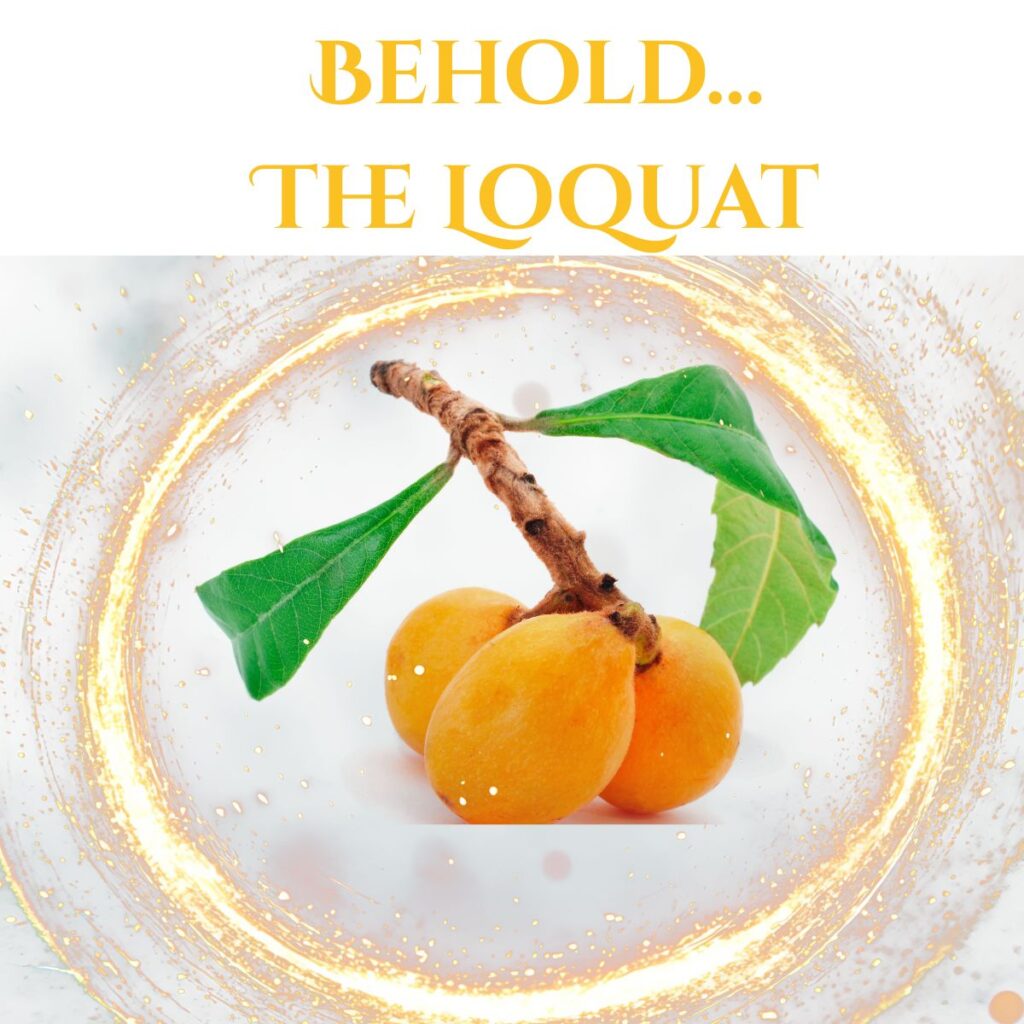
The Loquat (Eriobotrya japonica) is a perennial tree from East Asia, but now grown in many other regions due to the popularity as an ornamental and for the fruit.
The Loquat is symbolic of gold and wealth due to its color, as well as having auspicious associations with longevity, luck, and prosperity.
The Loquat tree can grow over 30 feet, but usually is smaller and has a nice round crown which many like for its ornamental quality with rough textured large dark green serrated leaves and dense tan pubescence on the underside of the leaves.
It produces stiff panicles of white sweet-scented flowers, smelling great in the garden, which later bear clusters of yellow-orange oval shaped fruits. The fruit is yummy and can be sweet with mango/peachy flavor, though sometimes a bit tart or acidic, depending on cultivar, with a large inedible seed in the center.
The fruits are enjoyed raw or sometimes processed into jams, jellies, chutney, confections, syrup or alcoholic beverages.
The seeds of certain low-cyanide varieties are also used for making liqueur similar to amaretto and a coffee substitute (when roasted).
The Loquat has a long history of use in Asian traditional medicine, especially for use in cough syrups.
➡️ The leaves are also typically used to make a Loquat leaf tea (called biwa cha). After the leaves are picked off the tree fresh, the underside of the leaf is scraped lightly with a knife to remove the hairs (which can be irritating to the throat), and then the leaves (used fresh or dried) are infused in boiling water. The tea is enjoyed for its health benefits and pleasant earthy flavor.
The leaves are considered to be useful for controlling blood sugar, pain relieving, expectorant, antitussive, antibacterial, antiviral, astringent and antiemetic.
Although less used medicinally, the fruit is also considered to be expectorant and slightly sedative.
Dired leaves or a decoction is used in cases of respiratory illness, fevers or as a mouthwash for thrush. Leave extracts and infusions are also used for glowing skin. And flower extracts are sometimes included for stomach health.
Through scientific investigation, Loquat has exhibited antioxidant, anti-inflammatory, analgesic, antiseptic, anti-allergy, antidiabetic and anti-aging properties, among others.
Behold the Loquat