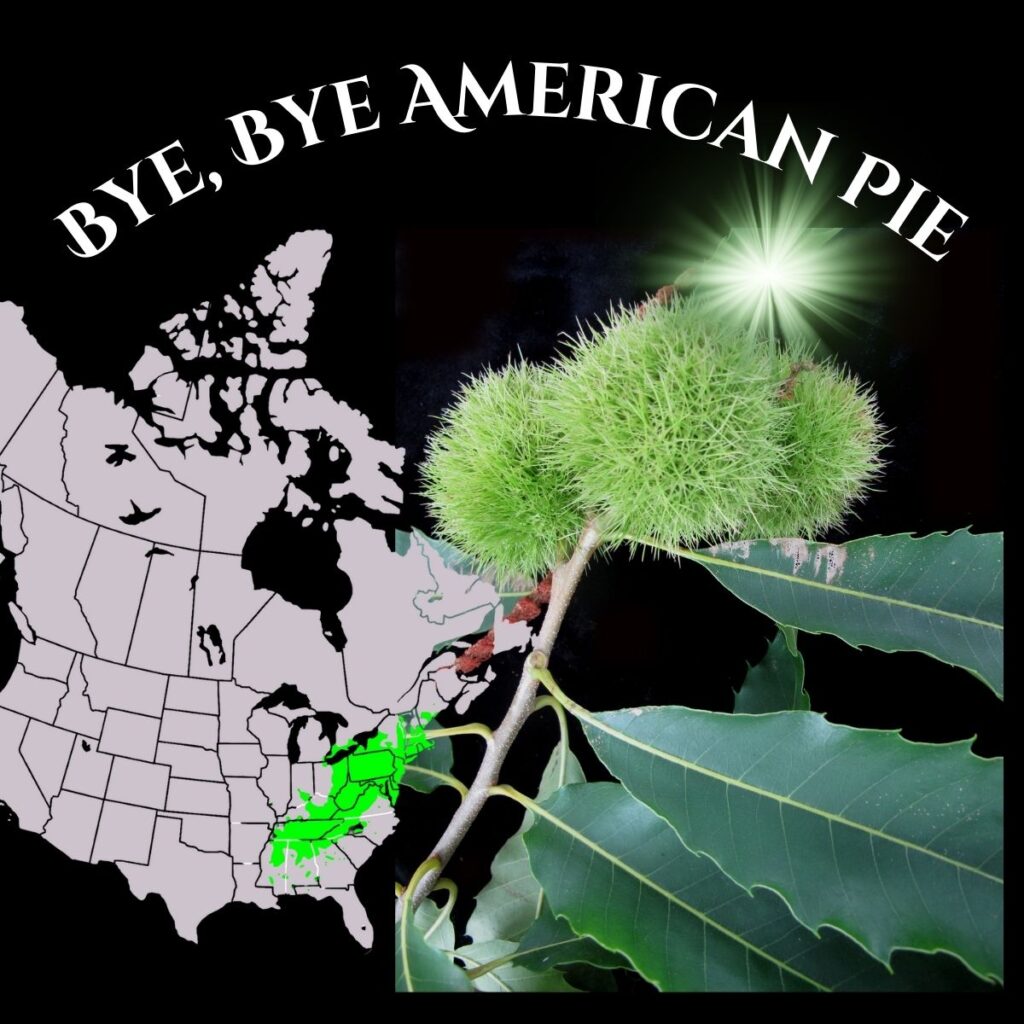
Sadly, the American Chestnut (Castanea dentata) used to be one of the dominant trees of the Northeastern US ranging all the way up through Canada, and south to Mississippi and Alabama and used to be of significant economic importance.
They are fast growing deciduous hardwood trees that could reach heights up to 100 feet, but today few get this tall as the population was decimated by a blight in the early 1900’s that killed up to an estimated 3 billion trees.
The blight was accidently introduced from Asiatic chestnut trees and quickly spread through the population which had little resistance to the disease.
The American Chestnut used to be an important tree for wildlife, as the chestnuts were consumed by black bear, passenger pigeons, wild turkey and white-tailed deer.
Besides their importance to the environment, they were also economically important to humans, as the chestnuts were sold throughout the towns of the Northeast, and were an important hardwood that is thought to be among the highest quality woods with a straight grain, resistant to decay, attractive, and fast growing.
Today, there are attempts to repopulate the native populations, and breeding programs exist that attempt to use no Asian genes in breeding American trees with high resistance.
There are also transgenic trees that have been developed with complete resistance to the blight, and said to possibly be the first genetically modified forest trees to be planted in the wild.
There are also alternative approaches that use no biotechnology, as breeding programs with naturally blight-resistant populations of pure American chestnuts discovered in Virginia in the 1970s are producing 100% pure American chestnuts with natural blight resistance.
✨ Today, around Christmas time when Chestnut-eating is most popular, it is usually European sweet chestnuts that are found in many stores in the US.
➡️ The American Chestnut, however, is reportedly the sweetest of the Chestnut species, and also makes a delicious oil by crushing and boiling the nuts.
Roasted nuts have also been used as coffee and chocolate substitutes. Besides eating Chestnuts on their own or “roasting on an open fire”, as is the tradition, Chestnuts make delicious pies, with the consistency of cheesecake.
They have historically also been used as traditional medicines by the Native Americans, preparing leaf teas for respiratory health, to calm the nerves of the respiratory system and assist with expectoration. While poultices made from young leaves treated burns, snakebites, sores, and swellings.
The bark was used in cold tea form (sometimes combined with buckeye) to stop bleeding after birth, and leaves were listed in the U.S. Pharmacopoeia (1873-1905) for their astringent and tonic properties due to their approximately 9% tannin content.
Ground nuts were applied as poultices for toothaches, and the leaves were boiled with mullein and brown sugar to create cough syrup.
Bye, Bye American Pie – The American Chestnut