
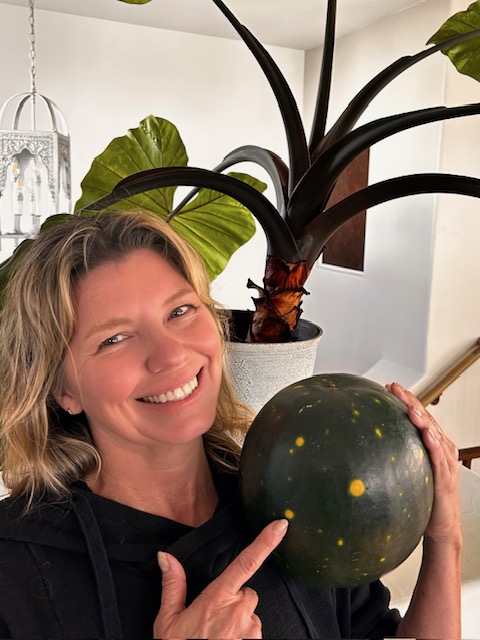
I found a Moon and Stars watermelon this week in my grocery store: a variety I never expected to see outside of seed catalogs and preservation circles. Deep green rind scattered with yellow speckles, like a night sky. It almost looks unreal.
More remarkable is the story behind it…
This heirloom variety dates back to the early 1900s and was once widely grown in the United States. Over time, like so many regionally adapted and culturally meaningful crops, it was pushed aside in favor of uniformity, shipping durability, and shelf-life.
➡️ At one point, it nearly disappeared.
It disappeared from seed catalogues in the 1920s and was thought to go extinct by about the 1970’s…one farmer heard about the search for it on television and by calling Seed Savers Exchange helped bring it back from the edge.
The fact that it showed up in a modern grocery store feels significant.
Because when we talk about “endangered food traditions,” we’re not just talking about rare plants, we’re talking about lost nutrition, flavors, lost genetics, and lost relationships between people and place.
Every time one of these varieties reappears in the marketplace, it raises an important questions:
What else have we lost that we haven’t even noticed yet?
And what would it look like to bring more of it back?