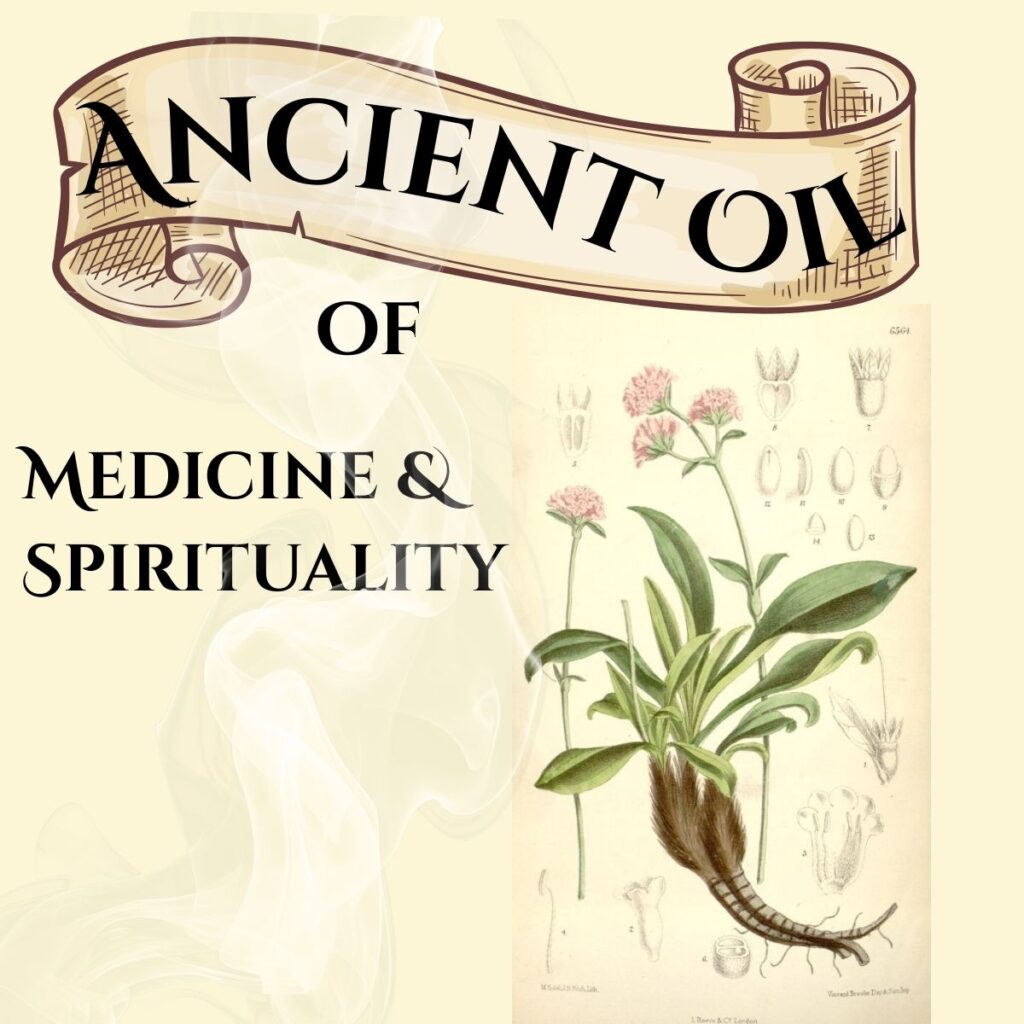
Spikenard (Nardostachys jatamansi, syn. N. grandiflora) is a Himalayan native in the honeysuckle family with pink bell-shaped flowers and dense fibrous root–rhizome masses that yield a thick, amber-colored essential oil known for its earthy, musky scent.
Since ancient times, this now critically endangered plant has been harvested, mainly for its rhizomes which are used as an incense and also from which an essential oil is extracted that has uses in perfumery, spirituality, and medicine.
➡️ Spikenard oil is historically valued as a luxury perfume, incense ingredient and ritual unguent in South Asian and Mediterranean cultures. The aromatic root and rhizome powders are blended into incense sticks and dhoop, used in temple offerings and household rituals, and sometimes incorporated into cosmetic and hair formulations for their scent and calming effects.
In traditional Himalayan trade, dried roots functioned as a high-value export commodity, and the plant’s strong dyeing and fixative properties in the oil contribute to its role in perfumery and incense rather than widespread culinary or textile use.
Spikenard is a prized medicinal plant in many traditional medicine systems including Chinese, Tibetan, Nepalese, Bhutanese, Indian and Japanese and has been named in classical ancient texts such as the Ayurvedic classics and the Old Testament.
Spikenard is considered a Sattvic herb: one that is consumed daily for both medicinal and spiritual properties.
It is considered in Ayurveda and related Himalayan traditions to be a nervine tonic and sedative used for stress-related disorders.
Spikenard is also often used in neurological disorders, such as insomnia, anxiety, depression and epilepsy.
Through scientific investigation, Spikenard has been found to have a wide range of activities, including antianxiety, anti-depression, antioxidant, anti-PMS, anticholinesterase, antihyperglycemic, anti-inflammatory, antiestrogenic, antidiabetic, antifungal, antimicrobial, antiasthmatic, antihypertensive and antityrosinase activity.
There is, however, some confusion on botany and also whether scientific studies have been conducted on correct species.
One notable preclinical study on chronic restraint stress in rats showed that Spikenard rhizome extract (200 mg/kg) protected against stress-induced impairments in spatial learning and memory, which was associated with modulation of hippocampal function and antioxidant defenses.
Another study found Spikenard extract reduced oxidative-stress–mediated anxiety in mice by lowering cortisol and lipid peroxidation, enhancing brain antioxidant enzymes, and normalizing GABA and monoamine neurotransmitters.
Spikenard: Ancient Oil of Medicine & Spirituality ✨