
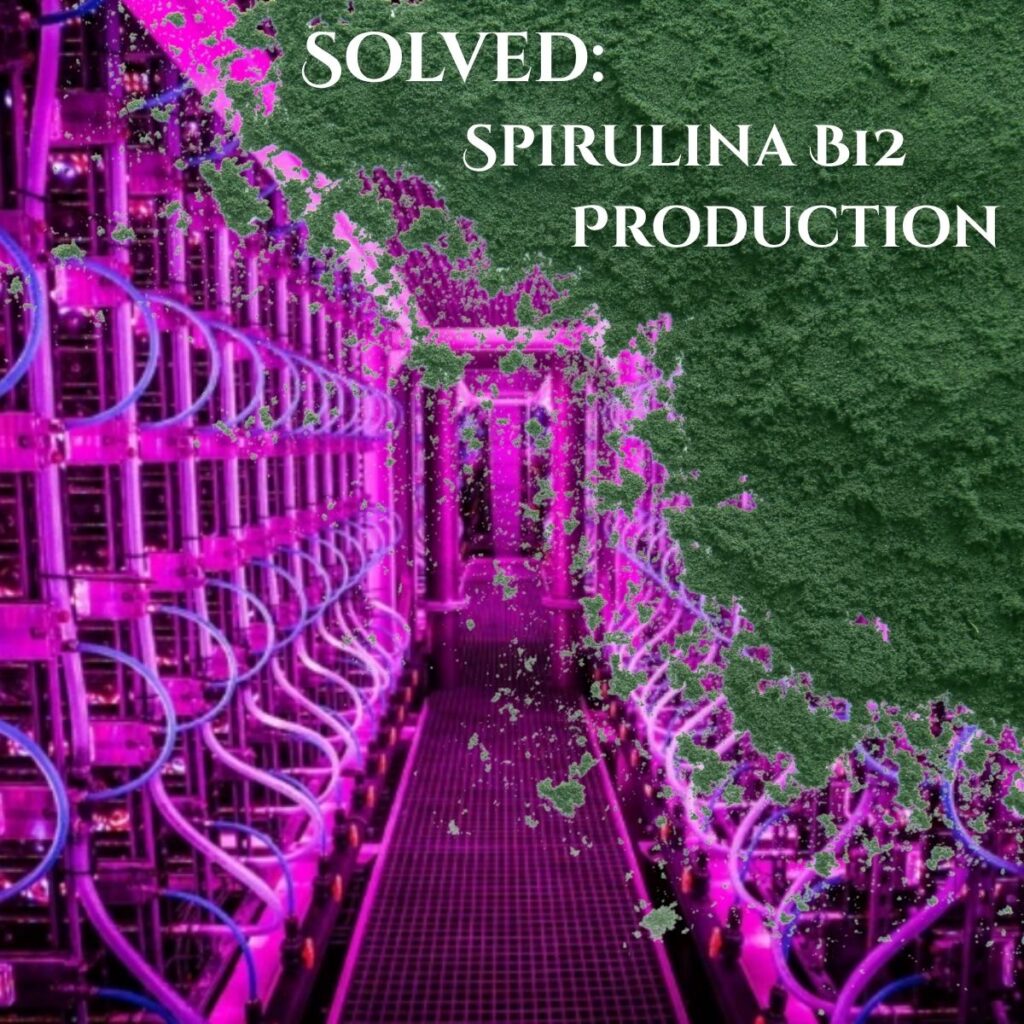
➡️ For years, Spirulina (Arthrospira platensis) has been marketed as a plant-based vitamin B12 source, even though most of its Spirulina B12 is actually “pseudo-B12,” a form the human body can’t use.
That gap has kept Spirulina from being a credible replacement for animal-sourced B12, despite its nutrient density and small environmental footprint.
Researchers led by Dr. Asaf Tzachor at Reichman University’s Aviram Sustainability and Climate Program, working with teams in Iceland, Denmark, and Austria, used a technique called photonic management (precisely controlling the light spectrum Spirulina grows under) to shift its biochemistry toward producing biologically active B12 instead of the inactive form.
🐄 Over a billion people globally have low B12 status, and animal agriculture’s environmental cost is a constraint on meeting that need.
The researchers modeled what happens if Iceland redirected electricity currently used by heavy industry toward this production system: roughly 278,000 tonnes of Spirulina biomass annually, yielding about 4,555 grams of active B12: enough to cover the RDA for over 13.8 million children ages 1–3, with more ambitious scenarios reaching 26.5+ million children in that age group or 50+ million infants aged 0–6 months.
Research Reference:
A. Tzachor, S. P. van den Oever, H. K. Mayer, M. Asfur, A. Smidt-Jensen, M. Geirsdóttir, S. Jensen, B. O. Smárason. Photonic management of Spirulina (Arthrospira platensis) in scalable photobioreactors to achieve biologically active unopposed vitamin B12. Discover Food, 2024; 4 (1)