In case you missed it…
Yesterday I gave my presentation on a panel for “Mushrooms 3.0” called “Grain of Truth:
Mushrooms, Labels and the Value of Biodiversity.”
This was part of a Naturally Informed event entitled Supply Chain, Delivery Systems and Technology: Powering the Future of the Natural and Nutraceutical Industry.” There is still one day left today, and if you register, you will receive the full recording. Register here: https://naturallyinformed.net/2026-supply-chain/
I gave some examples of the mushrooms we know and love, some up-and-comers and the evolving science, and explained how much of the product on the market today is something called “Mycelium on Grain (MOG)”.
I believe the various mushroom parts and ways of growing can each have benefit. So, I am not against MOG. The problem is that, based on lab testing of current retail products, the grain often never really goes away. They are often harvested too early, so that the final product that makes it to the market is largely substrate. Indicating that they were not grown properly, and certainly some are adulterated on the labeling.
So how do we fix it? Analytics & Transparency.
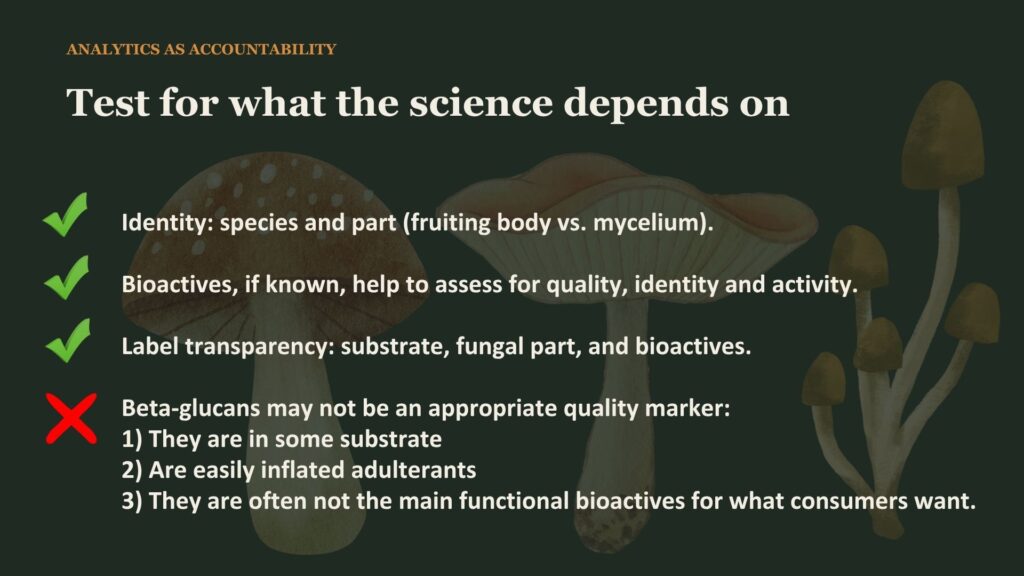
✅ First, confirm identity. Is it the right species? Is it the fruiting body or the mycelium? Use modern techniques like HPTLC and NMR to ensure the product is what is being claimed on the label. Extra points if you use a unique bioactive as a marker compound to confirm species and/or fungal part.
✅ Second, measure known bioactives as quality indicators. This is important to correlate claims with the available scientific research.
✅ Third, the label must transparently disclose what the product is, and what it is standardized to. If the product is a whole fruiting body, disclose that. If the product is mycelium on grain, disclose that appropriately. If it contains meaningful bioactives for your intended use, put that on the label.
None of this is exotic. These are tools we already have. We just have to use them and transparently show the results.
❌ I also wanted to point out that for many of these products Beta-glucans may not be an appropriate quality marker, because: 1) They are in some substrate 2) Are easily inflated adulterants 3) They are often not the main functional bioactives for the benefits consumers are looking for.
Grain of Truth: Mushrooms, Labels and the Value of Biodiversity.