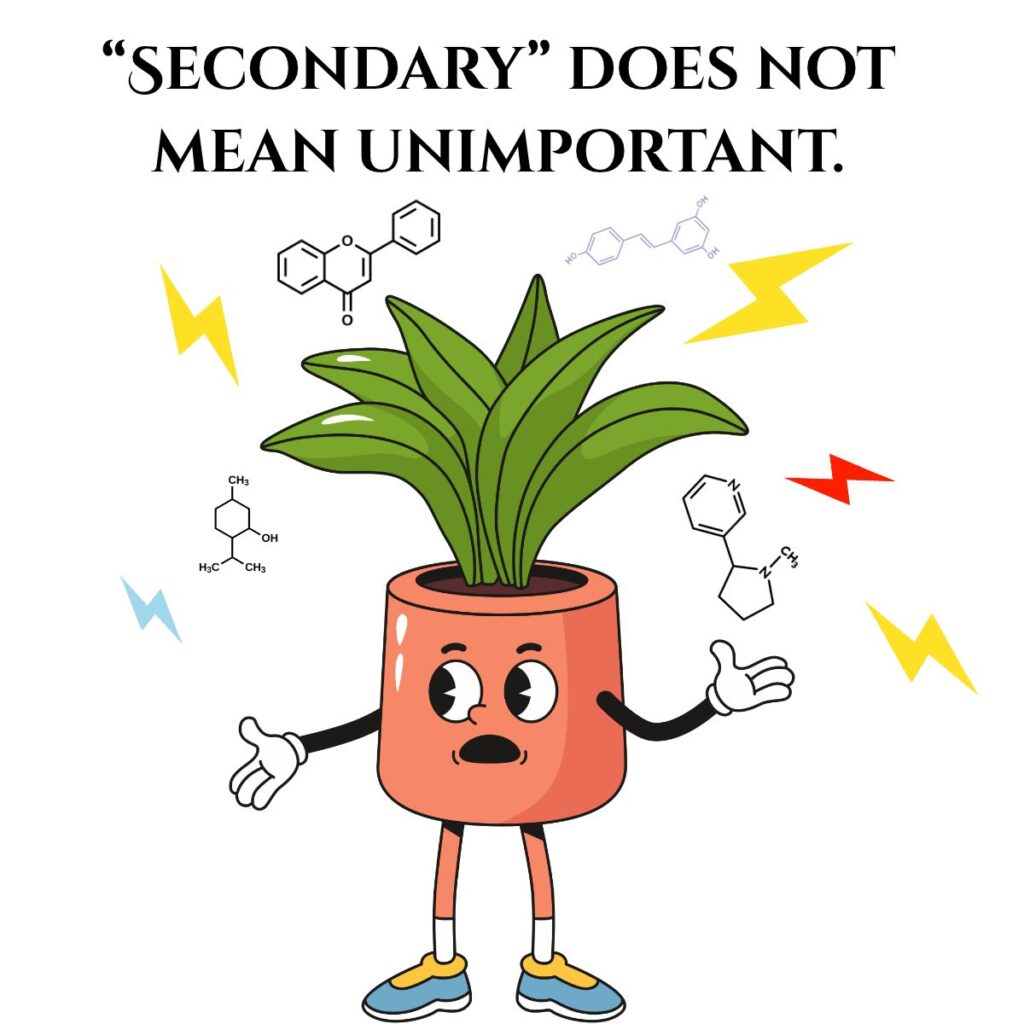
Plant secondary metabolites include compounds involved in defense, attraction, interactions with microbes, and responses to environmental conditions. Some also participate in regulating the plant’s own growth and development.
They are not simply decorative extras.
Yet that is the terminology many of us learned.
Their chemistry helps explain how a plant survives in a world where it cannot walk away from a hungry herbivore or an unfavorable growing environment.
And when we encounter that chemistry, it can interact with our biology, too.
The plant compounds usually termed as part of the “primary metabolism” of the plant includes the ones we have given the most regulatory importance, as we have given values to carbohydrates, proteins and fats in foods.
Whereas, the “secondary metabolites”, which includes the alkaloids, the polyphenols and flavonoids, have always been present in our diet in an evoloutionary sense and have been recently stripped from our food supply.
“Secondary” describes a historical classification.
It should not determine how seriously we take the chemistry and our need for it for health.
“Secondary” Does Not Mean Unimportant, When it Comes to Plant Chemistry.